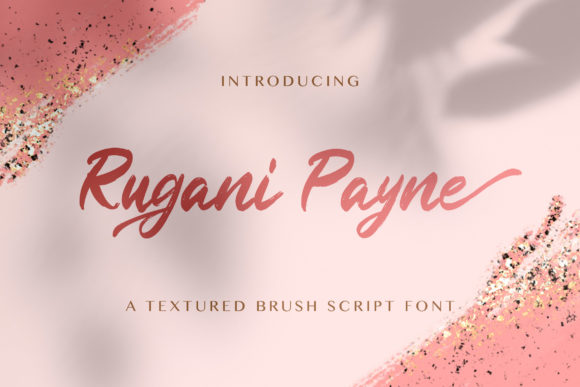
Rugani Payne: A Textured Hand Brush Font for Authentic Branding
I was staring at a blank brand board, trying to find the right voice for a new artisanal skincare line. The brief called for something organic, raw, and deeply personal, but every standard script font felt too polished or overly decorative. I needed texture. I needed imperfection that still read clearly. That’s when I pulled up Rugani Payne. It wasn’t just another script; it had a distinct hand-brushed character that immediately grounded the entire visual identity.
If you are a designer looking to inject personality into your projects without sacrificing readability, this textured hand brush handwritten font deserves a spot in your toolkit. After testing Rugani Payne across logos, packaging mockups, and digital layouts, here is my honest take on how it performs in real-world branding scenarios.
The Visual Personality of Rugani Payne
Rugani Payne belongs to the Script Handwritten category, but it distinguishes itself through its unique textural quality. Unlike smooth vector scripts that look digitally generated, Rugani Payne mimics the natural variation of a brush hitting paper. The strokes have weight, taper, and a slight roughness that conveys authenticity. This makes it an excellent choice for brands that want to appear human-centric and approachable.
The font’s mood is relaxed yet confident. It doesn’t scream for attention like a bold display font, nor does it whisper like a delicate calligraphy script. Instead, it holds its own with a steady, artistic presence. When I placed it on a business card draft for a local coffee roaster, it instantly elevated the design from "generic template" to "curated experience." The texture adds depth, making even simple black-and-white designs feel tactile and premium.
Testing Rugani Payne in Real Branding Projects
To truly understand a typeface, you have to break it out of the design software and see it in context. Here is how Rugani Payne performed across various design assets during my recent project work.
Logo Design and Brand Identity
Using a handwritten font for a logo is a risk. If the letterforms are too complex, they lose legibility at small sizes. However, Rugani Payne strikes a balance. Its moderate x-height and clear letter structures ensure that even simplified versions remain recognizable. I used it as the primary logotype for a boutique creative studio. Paired with a clean sans serif font for the subheading, it created a perfect hierarchy. The contrast between the organic brush strokes of Rugani Payne and the geometric precision of the supporting typography made the brand feel both modern and handmade.
Packaging and Product Labels
In packaging design, shelf impact is everything. Rugani Payne excels here because its texture catches the eye. On a mockup for a handmade soap label, the font’s irregular edges added visual interest that plain text couldn’t achieve. It works particularly well for short phrases, product names, or taglines. Just be mindful of scale; while it looks stunning large on a box, it may become difficult to read on very small ingredients lists. Use it as a hero element, not body text.
Social Media Graphics and Web Headers
Digital spaces often demand crisp, high-contrast typography, but there is room for personality. I tested Rugani Payne on Instagram story templates and website hero sections. On social media, where users scroll quickly, the unique brush style stands out against more uniform feeds. For web headers, it serves as an engaging accent. I paired it with a modern sans serif font for navigation menus, allowing the headline to carry the emotional weight while the functional text remained easy to scan. This combination enhances user engagement by creating a memorable first impression.
Practical Considerations and Limitations
No font is a one-size-fits-all solution. While Rugani Payne is versatile, it has specific use cases where it shines and others where it struggles.
- Best Used As: Display font, headline font, logo accent, decorative text, short phrases, and product labels.
- Not Suitable For: Long body text, legal disclaimers, or formal corporate documents. Its handwritten nature can cause eye fatigue if readers are forced to process paragraphs of it. Additionally, due to its textured edges, it may not render cleanly at very small point sizes (below 10pt) or in low-resolution print environments.
Another technical note is that Rugani Payne is PUA encoded. This means access to certain characters or alternates might require using the Public Use Area in your font editor. While this allows designers to access all the unique glyphs and swashes, it requires a bit more setup than standard Unicode fonts. Make sure your workflow supports PUA encoding before committing to it for a large-scale project.
Font Pairing and Technical Details
One of the biggest challenges with creative fonts is finding complementary typefaces. Because Rugani Payne is visually busy, it pairs best with neutral, understated fonts. A clean sans serif font like Helvetica Now or Montserrat provides the necessary contrast to let the script breathe. Alternatively, a classic serif font can add a touch of elegance if you are aiming for a more traditional aesthetic.
When reviewing the file, check for included styles, alternates, and ligatures. These features allow you to customize the flow of the text, preventing awkward spacing between letters. If the package includes multilingual support, that is a significant bonus for global brands, though you should verify language coverage beforehand. Regarding webfont availability, always check if a web-ready version is included to ensure consistent rendering across different browsers.
Final Tips for Implementation
Before integrating Rugani Payne into final client work, I recommend creating a comprehensive test suite. Print it out on different materials—matte paper, glossy stock, and even fabric—to see how the texture translates physically. Digital screens do not always capture the nuance of a hand-brushed effect.
Also, remember to review commercial font licensing carefully. Using a premium font in client work, brand identity systems, merchandise, or print-on-demand products usually requires a proper license. Ensure you have the rights to use Rugani Payne for your specific application to avoid legal issues down the line.
Ultimately, Rugani Payne is more than just a font; it is a tool for storytelling. It brings a sense of craft and care to any design project. Whether you are refreshing a café’s visual identity or launching a new handmade shop, this textured hand brush handwritten font offers the authentic touch that today’s audiences crave. By testing it thoroughly and pairing it wisely, you can create brand assets that are not only beautiful but also effective.